


Badminton doubles service rules are often confusing for beginners and even regular players, because one small mistake can cost you a point. In the first few rallies of a match, many service faults happen simply due to misunderstanding rotation, service courts, or who should serve next. This guide explains everything in simple language, step by step, so you can play confidently and correctly.
Why Understanding Doubles Service Rules Is Important
In doubles badminton, service rules are stricter than singles. One wrong serve means:
- Immediate loss of the rally
- A break in momentum
- Confusion between partners
- Arguments during friendly or competitive matches
Whether you play at school, academy, club level, or local tournaments, knowing the rules helps you avoid faults and focus on winning rallies instead of debating them.
Basic Overview of Badminton Doubles Service Rules
Before going deep, let’s understand the foundation.
In doubles:
- Each side has two players
- Only one player serves at a time
- A side continues serving as long as they keep winning points
- Service courts change based on the score (even or odd)
Unlike the old scoring system, modern badminton uses rally point scoring, which applies to all official matches.
Read more: Badminton court cost guide
Official Scoring System Used in Doubles
According to the Badminton World Federation (BWF):
- Each game is played to 21 points
- Every rally awards one point, regardless of who served
- A match is best of three games
- At 20–20, play continues until one side leads by 2 points
- Maximum score cap is 30 points
This scoring system directly affects service court position.
Service Court Basics in Doubles
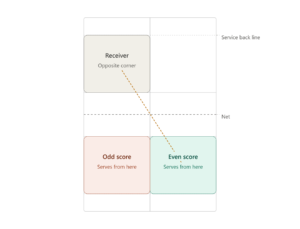
The court is divided into a right service court and a left service court. Which one you serve from depends on your team’s score, not your opponent’s.
Even & Odd Rule
- Even score (0, 2, 4, 6…) → Serve from the right court
- Odd score (1, 3, 5, 7…) → Serve from the left court
This rule applies every time your team has the service.
Who Serves First in a Doubles Match?
Before the match starts:
- A toss is done
- The winner of the toss chooses either to serve first, or which side of the court to start from
The player who starts serving becomes the first server for that side.
Service Order in Badminton Doubles (Most Confusing Part)
This is where most players get confused.
Key Rule
At the start of the game, only one player from the serving side serves. There is no “second serve” like in old scoring rules.
How Rotation Works
- If the serving side wins the rally, they score a point, continue serving, and change service court based on the updated score
- If the serving side loses the rally, service passes to the opponents
Simple Table: Doubles Service Rules Explained
| Situation | Who Serves | Service Court |
|---|---|---|
| Start of game | Player who won the toss | Right court (score 0) |
| Score is even | Same server | Right court |
| Score is odd | Same server | Left court |
| Server’s side loses rally | Opponent serves | Based on their score |
| Opponent wins rally while receiving | They score and serve | Based on their score |
This table alone clears up most of the confusion for beginners.
Receiving Position Rules in Doubles
When receiving serve:
- Only the correct receiver can return the serve
- Their partner must stand diagonally opposite
- If the wrong player receives it, it’s a fault
After the serve is returned, both players are free to move anywhere on the court.
Serving Position Rules (Very Important)
At the moment of serving:
- Both feet of the server must be in contact with the court and inside the correct service court
- The shuttle must be hit below the server’s waist, with the racket shaft pointing downward
- The serve must be hit diagonally and land in the correct service court
Any violation of these results in a service fault.
What Is Considered a Fault in Doubles Service?
Common service faults include:
- Shuttle hit above waist level
- Racket shaft not pointing downward
- Feet touching boundary lines
- Wrong player serving
- Wrong service court
- Shuttle landing outside the service court
Knowing these helps you avoid giving away free points.
Difference Between Singles and Doubles Service Rules
Many players mix up singles and doubles rules.
| Rule Aspect | Singles | Doubles |
|---|---|---|
| Service court width | Narrow | Wide |
| Service court length | Long | Short |
| Rotation complexity | Simple | More complex |
| Partner involvement | No | Yes |
This is exactly why doubles service needs extra attention.
Short Service Line Rule in Doubles
In doubles, the back boundary for a legal serve is shorter than in singles — the shuttle must land before the doubles long service line, which sits closer to the net than the singles back boundary. Players used to singles rules often overshoot the serve unintentionally when switching to doubles.
Common Doubles Service Mistakes Players Make
From real court observations, the most frequent mistakes are:
- Forgetting the score-based service court
- The wrong partner serving after a point loss
- Standing outside the service court while serving
- Using singles service length in doubles
- Both partners moving before the serve is hit
Avoiding these instantly improves match performance.
How to Remember Doubles Service Rules Easily
Here’s a simple memory trick: score decides side, not the player.
And:
- Win the rally → same side serves
- Lose the rally → service changes
- Even score → right court
- Odd score → left court
Repeating this during matches helps reduce confusion over time.
Practical Tip for Club & School Matches
Before every serve:
- Quickly say the score out loud
- Confirm who is serving and from which side
This habit is followed even in professional matches.
Badminton Doubles Service Rules for Beginners
If you’re new to badminton:
- Focus only on the score (even/odd) and the correct service court
- Ignore advanced tactics initially
- Play slow practice games to build confidence
Rules become natural with repetition.
Rules in Official Tournaments vs. Casual Play
In official tournaments, service faults are strictly judged — umpires check waist height, racket angle, and foot position.
In casual games, rules may be relaxed, but learning the official rules is always better for players who want to progress to club or competitive levels.
What Happens If Players Serve in the Wrong Order?
If a service-order mistake is discovered during play:
- The rally already played stands
- The correct order is restored after that rally
- The score remains unchanged
This rule prevents unnecessary stoppages mid-match.
Read more: Badminton court lighting standards
BWF Authority on Doubles Service Rules
The Badminton World Federation (BWF) is the governing body for badminton worldwide. All official doubles service rules are defined in the Laws of Badminton, which govern play at the Olympics, World Championships, and international tournaments. Following BWF rules ensures standard play everywhere, from school matches to professional tournaments.
Final Thoughts
Understanding badminton doubles service rules may feel difficult at first, but once you break them into simple steps — score, court, server — they become easy to follow. Most service mistakes happen not from a lack of skill, but from a lack of rule clarity.
If you play regularly, mastering these rules will reduce unnecessary faults, improve teamwork with your partner, and increase your confidence during matches. Take a few games to consciously apply these rules, and soon they’ll become second nature.
Setting up a badminton court for practice? Gallant Sports designs indoor and outdoor badminton courts with BWF-standard markings, proper flooring, and lighting — get in touch to plan your setup.
FAQ
1. What are badminton doubles service rules in simple words?
Answer: Badminton doubles service rules decide who serves, from which side, and where the shuttle must land. The server serves diagonally, the service court depends on the team’s score (even or odd), and only one player serves at a time.
2. How do I know which service court to use in doubles?
Answer: It depends on your team’s score: even score (0, 2, 4…) means the right service court, odd score (1, 3, 5…) means the left service court. This rule applies every time your team serves.
3. Who serves first in a badminton doubles match?
Answer: The team that wins the toss decides whether to serve first or choose their starting side. The player who starts serving becomes the first server of that game.
4. Is there a second serve in badminton doubles?
Answer: No. In the current scoring system, there’s only one serve per side. If the serving team loses the rally, service immediately goes to the opponents.
5. Can the wrong player return the serve in doubles?
Answer: No. Only the correct receiver, standing diagonally opposite the server, can receive the serve. If the wrong player hits the shuttle, it’s a fault.
6. Why is the doubles service court wider but shorter than the singles court?
Answer: The doubles court is wider to account for two players covering the court, but the service back boundary is shorter than in singles, since doubles rallies are typically played closer to the net.
