


Hockey moves faster than almost any other field sport, and the turf underneath has to keep pace with it. Ball roll, ball rebound, and how the surface responds to impact all have to stay within a tight band, in the rain and in the dry, or the game itself changes. That’s exactly what the International Hockey Federation (FIH) tests for before it certifies a field.
Gallant Sports is an FIH registered builder, with certified hockey fields including the SMS Stadium in Jaipur and the District Sports Ground in Ariyalur, Tamil Nadu. We’ve built hockey turf as part of more than 800 sports infrastructure projects across 28 states, supplying and installing over 15 million square feet of surfacing nationwide, and we manage FIH-standard hockey fields from base design through certification-ready handover.
A hockey field is judged on how consistently it performs, not just how it looks. FIH testing covers ball roll, ball rebound, and impact response, and a field has to hold those numbers within range in both dry and wet conditions to earn certification. That consistency starts well below the turf surface.
Foundation and base. An asphalt base with drainage running around the field is what keeps water moving off the surface instead of pooling on it. Get this wrong and no turf specification above it will save the field from waterlogging.
Shock absorption. Shock pads, typically 10–15mm thick, sit beneath the turf to cushion impact for players’ joints and reduce injury risk over a full match or a full season of training.
Wet play performance. Most competitive hockey is played wet, which means the field needs a sprinkler system and sump designed to distribute water evenly without letting it pool. This is what keeps ball speed and roll consistent through a match.
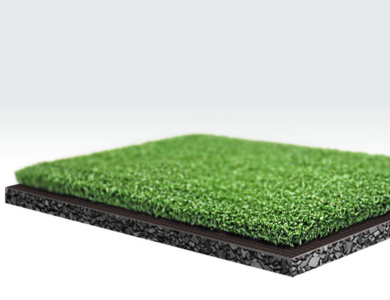
A rigorous, low-pile system (around 13mm) built for the highest level of competitive play, including international and elite national matches. This is the specification used at fully certified international venues.

An 18mm sand-filled system built to FIH National standards, suited to national-level competitions and high-performance training facilities that don't require Global Elite certification.
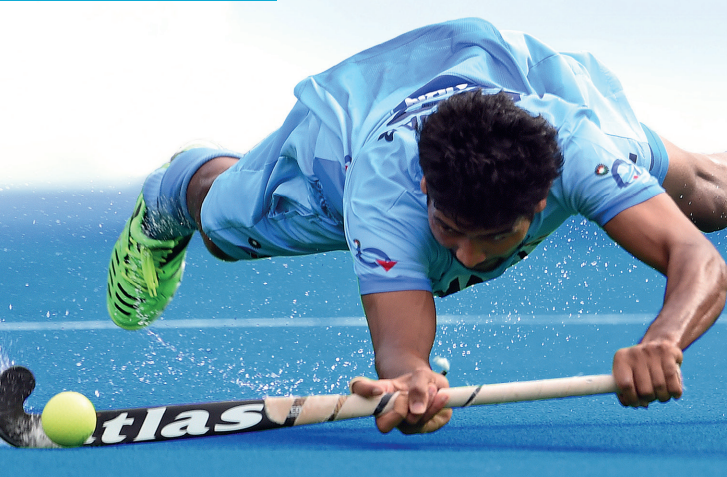
A system built for multi-level play and junior training, where full wet-pitch irrigation isn't part of the brief. A practical option for schools and academies focused on skill development over elite competition.
The FIH categorises fields by playing level, Global Elite for international matches, Global for high-level competitions, National for national-level play, and Multi-Level for a broader range of uses including junior training. We help institutions choose the right category for what the field actually needs to support, rather than over-specifying for a level of play the facility won’t use.
Government sports bodies and stadiums commission full-size, FIH-certified hockey fields for state and national-level competition, where certification is often a non-negotiable part of the brief.
Schools and academies build hockey turf for training and school-level competition, frequently opting for dry or multi-level turf systems suited to junior development.
Sports academies invest in national or global-standard turf where the goal is preparing players for higher-level competition.
Corporate and community sponsors back smaller-scale hockey fields, including 5-a-side formats, as part of local sport development initiatives, since full-size fields typically require the land and investment that government projects bring.
Gallant Sports is an FIH registered builder with 9+ certified fields including SMS Stadium in Jaipur and the District Sports Ground in Ariyalur, Tamil Nadu. Across more than 800 projects and 28 states, we’ve supplied and installed over 15 million square feet of sports surfacing, including hockey turf for schools such as Shivalik School in Chandigarh, MAHE Manipal and all.
We manage the field from base design and drainage planning through turf installation and certification coordination, so government bodies, schools, and academies get one accountable team from groundbreaking to handover.
It means our hockey field construction meets the standards set by the International Hockey Federation for ball roll, ball rebound, and impact response. We've built FIH-certified fields including the SMS Stadium in Jaipur and the District Sports Ground in Ariyalur.
Global Elite Level fields are built for international matches. Global Level suits high-level competition. National Level is built for national-level play. Multi-Level fields cover a broader range of uses, including junior training, without requiring elite-level specification.
Most competitive hockey is played wet, so fields intended for national or global-level play need a sprinkler system and sump for even water distribution. Dry hockey turf, used mainly for training and junior development, doesn't require this.
Shock pads typically run 10–15mm, providing cushioning that reduces impact on players' joints. The right thickness depends on the level of play and expected usage.
A full-size FIH hockey field requires significant land, which is why full-size fields are usually government-backed projects. Smaller 5-a-side formats need considerably less space and suit private or institutional investment.
Yes. Gallant Sports has built hockey turf projects across 28 states in India, including certified fields in Rajasthan and Tamil Nadu, and our team travels for site assessment and installation nationwide.
FIH testing measures how consistently the ball moves and bounces across the field. This is what separates a certified field from a general-purpose turf.
A properly built field performs predictably whether it’s being irrigated for match play or used dry for training.
Shock pads beneath the turf reduce joint impact and injury risk across a full season of play.
An asphalt base with surrounding drainage prevents waterlogging and keeps the field playable after heavy rain.
We've always believed in looking after our students and facilitating an overall development of their characters. There is where sport comes into play and the right sporting infrastructure is of utmost importance to say the least. We would like to thank Gallant Sports from the bottom of our hearts for doing such a wonderful job of transforming our vision into reality. The Product which we decided to go ahead with is called Superb and truth be told, we haven't been disappointed. We look forward to working with Gallant Sports in the future.
Brother Varghese
St. George’s College, Mussoorie
We are happy that we contracted Gallant Sports & Infra Ltd, for the installation of multiple indoor and outdoor sports facilities at our school premises. The Gallant Sports team created the plan and oversaw the completion of one full size football field, cricket nets, basketball and badminton courts, skating rink and a children's play area covering a total area of 1,00,000 sq.ft. with superior quality products that our students are thoroughly enjoying using. The project was well co-ordinated including the civil works required and implemented in a timely manner. The client servicing team was always hands on and available to address our queries and concerns throughout the duration of the project.We highly recommend Gallant Sports & Infra Ltd. for similar projects and wish them the best in the future.
Ms. Poonam Gupta
Principal, BGS International School
At Shivalik School, we believe sports play a vital role in shaping character and nurturing growth. Gallant Sports has completely transformed our sports infrastructure with exceptional football, hockey, and basketball courts, setting a new standard for excellence. Their professionalism, meticulous attention to detail, and unwavering commitment to quality are truly outstanding.
The new facilities have sparked immense excitement among our students, who are thoroughly enjoying every moment of play and practice. Gallant Sports has been a trusted partner in bringing our vision to life, and we highly recommend their world-class sports solutions to anyone looking to inspire greatness through sports.
Mr. BS Bedi
Shivalik School, Chandigarh
Gallant Sports has infused a new spirit of energy and excellence at Atlantis School with their outstanding multi-sports facilities. From basketball and football to volleyball, kho-kho, and a professional running track, every element has been meticulously designed to inspire and elevate student performance.
What truly sets Gallant Sports apart is their seamless coordination, timely delivery, and unwavering commitment to quality. Their civil team worked in perfect harmony with ours, ensuring flawless execution and clear communication throughout the project. We are proud to have partnered with Gallant Sports, as our students now enjoy world-class facilities that motivate them to excel, compete, and achieve new milestones.
Mr. Vasu
Atlantis School, Tirupati
At Nagarvala School, we are committed to providing an environment where our students can thrive in all aspects of life, and sports play an integral role in that journey. Gallant Sports has truly elevated our campus with state-of-the-art facilities that have brought a new vibrancy to our school.
Their team’s expertise and attention to detail were evident throughout the entire process, ensuring that every aspect of the project was executed to perfection. We are grateful to Gallant Sports for helping us create a space that will nurture talent, inspire teamwork, and encourage a lifelong love for physical activity.
Mr. Dalal
Principal, Nagarvala School, Pune
Transforming sports infrastructure into a world-class experience was pivotal for Sparsh Global School, and Gallant Sports exceeded our expectations. More than a service provider, they became a true partner, sharing our vision and delivering it with precision and care.
From the outset, their team meticulously understood our needs, crafting a dynamic sports complex tailored for excellence. The result is extraordinary: a football field with a race track, along with padel tennis, basketball, and volleyball courts—all designed to inspire and energize. The passion and enthusiasm in our students today stand as a testament to the transformative impact of these remarkable facilities. .
Mr. Kedia
Owner, Sparsh Global School, Greater Noida


