


At Gallant Sports & Infra Ltd., we design and build padel tennis courts for clubs, academies, schools, and commercial sports venues across India. Founded in 2016 in Gurugram, Haryana, we have completed approximately 800 sports infrastructure projects, and we lay out padel courts to the dimensions set by the International Padel Federation (FIP).
In padel, the point doesn’t end when the ball reaches the glass. Players let it come off the back and side walls and play it again, so the enclosure is as much a part of the game as the turf. If a glass panel isn’t fixed properly or the surface bounces unevenly, players notice straight away.
We manage the project from site assessment and base work through to turf installation, glass and fencing, and final line marking, so you deal with one team for the whole court.
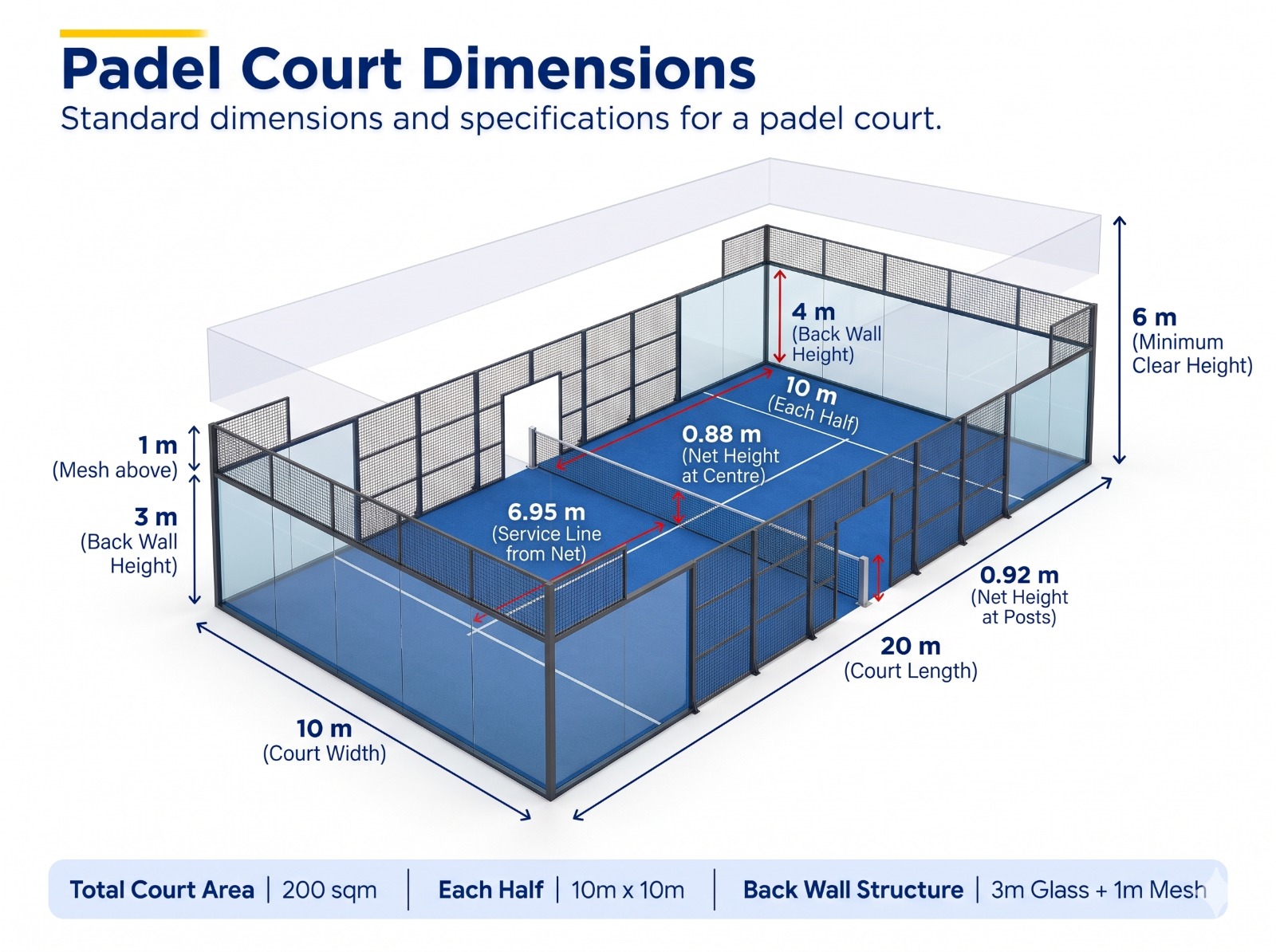
A padel court is a 20m x 10m enclosed court divided by a net, with toughened glass and fencing around the playing area. The game combines elements of tennis and squash: the scoring and net feel familiar from tennis, while the walls bring in the rebounds of squash.
It is played on a smaller court than tennis and is easy to pick up, which is a big part of its appeal. Beginners can enjoy rallies early on, while experienced players can use the walls in more advanced ways.
Artificial Turf Surface
Padel needs a surface with the right balance of traction, ball bounce, and player comfort. We use 12mm textured artificial turf to provide that balance across the full court.
Toughened Glass Walls
Toughened glass keeps the ball in play while maintaining visibility. It also lets spectators follow the game from different angles, which adds to the social side of padel.
Fencing
Fencing completes the enclosure above and around the glass, so the ball stays within the court during play.
Base and Structure
A padel court needs a level, stable base, with the enclosure’s steel posts fixed to a concrete foundation. Getting this right matters because the surface and the walls both depend on it.
Lighting
Good lighting extends playing hours into the evening, which is especially useful for clubs and commercial venues. See our stadium lights range.
Sports clubs and academies add padel courts to give members a new sport that’s easy to learn and suits coached sessions.
Commercial sports arenas build padel courts alongside other sports, often as part of a larger multi-sport venue.
Schools and colleges include padel in campus sports plans, usually alongside football, basketball, and other facilities.
Residential and hospitality projects offer padel as an amenity, since a single court needs far less land than a tennis court.
Gallant Sports has completed approximately 800 sports infrastructure projects in various states across India. Our padel work includes courts at Sparsh Global School in Greater Noida, built as part of a wider sports complex, and at Zyng Sports Arena in Noida, a multi-sport venue that also offers football, box cricket, and pickleball.
We handle site assessment, base work, turf, glass, fencing, and installation as one team, so clubs and developers aren’t coordinating separate contractors for each part of the court.
A padel court is 20m x 10m, enclosed by toughened glass and fencing.
Padel is played on a smaller, enclosed court where the ball can be played off the walls, somewhat like squash.
No. Padel is easy to pick up, so both beginners and experienced players can enjoy it.
The toughened glass and fencing keep the ball in play. The glass also lets spectators watch from all sides.
Yes. Padel works both indoors and outdoors. Indoor courts need enough clear height, with a minimum of 6m above the playing surface, while outdoor courts need a base that handles rainwater well.
Artificial turf is the most widely used surface. We use 12mm textured artificial turf, which balances traction, ball bounce, and player comfort.
We lay out padel courts to FIP dimensions. If your court needs formal FIP approval for competition, tell us at the start so we can confirm the requirements on a per-project basis.
Cost depends on the turf, glass walls, fencing, lighting, base work, and site conditions. Share your location and site details, and we’ll prepare a quote after a site assessment.
Yes. Gallant Sports has completed sports infrastructure projects in various states across India, and our team travels for site assessment and installation.
Padel Court | Dimensions |
Court Size | 20m x 10m (200 sqm) |
Each Half | 10m x 10m |
Net Height (Centre) | 0.88m |
Net Height (Posts) | 0.92m |
Service Line | 6.95m from the net |
Back Wall Height | 4m (typically 3m of glass with 1m of mesh above) |
Minimum Clear Height | 6m |
The surface has to give a regular bounce across the court, because players often let the ball land before playing it off the walls.
The walls need to give a reliable rebound and stay securely fixed. Glass quality and installation directly affect both safety and play.
Outdoor courts need a level base with good water runoff, so the court is ready to use soon after rain.
Lobs are a big part of padel, so overhead clearance matters on indoor courts. Allow extra space around the court for access and movement as well.
We've always believed in looking after our students and facilitating an overall development of their characters. There is where sport comes into play and the right sporting infrastructure is of utmost importance to say the least. We would like to thank Gallant Sports from the bottom of our hearts for doing such a wonderful job of transforming our vision into reality. The Product which we decided to go ahead with is called Superb and truth be told, we haven't been disappointed. We look forward to working with Gallant Sports in the future.
Brother Varghese
St. George’s College, Mussoorie
We are happy that we contracted Gallant Sports & Infra Ltd, for the installation of multiple indoor and outdoor sports facilities at our school premises. The Gallant Sports team created the plan and oversaw the completion of one full size football field, cricket nets, basketball and badminton courts, skating rink and a children's play area covering a total area of 1,00,000 sq.ft. with superior quality products that our students are thoroughly enjoying using. The project was well co-ordinated including the civil works required and implemented in a timely manner. The client servicing team was always hands on and available to address our queries and concerns throughout the duration of the project.We highly recommend Gallant Sports & Infra Ltd. for similar projects and wish them the best in the future.
Ms. Poonam Gupta
Principal, BGS International School
At Shivalik School, we believe sports play a vital role in shaping character and nurturing growth. Gallant Sports has completely transformed our sports infrastructure with exceptional football, hockey, and basketball courts, setting a new standard for excellence. Their professionalism, meticulous attention to detail, and unwavering commitment to quality are truly outstanding.
The new facilities have sparked immense excitement among our students, who are thoroughly enjoying every moment of play and practice. Gallant Sports has been a trusted partner in bringing our vision to life, and we highly recommend their world-class sports solutions to anyone looking to inspire greatness through sports.
Mr. BS Bedi
Shivalik School, Chandigarh
Gallant Sports has infused a new spirit of energy and excellence at Atlantis School with their outstanding multi-sports facilities. From basketball and football to volleyball, kho-kho, and a professional running track, every element has been meticulously designed to inspire and elevate student performance.
What truly sets Gallant Sports apart is their seamless coordination, timely delivery, and unwavering commitment to quality. Their civil team worked in perfect harmony with ours, ensuring flawless execution and clear communication throughout the project. We are proud to have partnered with Gallant Sports, as our students now enjoy world-class facilities that motivate them to excel, compete, and achieve new milestones.
Mr. Vasu
Atlantis School, Tirupati
At Nagarvala School, we are committed to providing an environment where our students can thrive in all aspects of life, and sports play an integral role in that journey. Gallant Sports has truly elevated our campus with state-of-the-art facilities that have brought a new vibrancy to our school.
Their team’s expertise and attention to detail were evident throughout the entire process, ensuring that every aspect of the project was executed to perfection. We are grateful to Gallant Sports for helping us create a space that will nurture talent, inspire teamwork, and encourage a lifelong love for physical activity.
Mr. Dalal
Principal, Nagarvala School, Pune
Transforming sports infrastructure into a world-class experience was pivotal for Sparsh Global School, and Gallant Sports exceeded our expectations. More than a service provider, they became a true partner, sharing our vision and delivering it with precision and care.
From the outset, their team meticulously understood our needs, crafting a dynamic sports complex tailored for excellence. The result is extraordinary: a football field with a race track, along with padel tennis, basketball, and volleyball courts—all designed to inspire and energize. The passion and enthusiasm in our students today stand as a testament to the transformative impact of these remarkable facilities. .
Mr. Kedia
Owner, Sparsh Global School, Greater Noida


