


If you’ve ever watched a volleyball match and thought, “Wait, what exactly does each player do?”, you’re not alone. Volleyball looks simple at first: just hit the ball over the net, right? But once you dig in, you’ll realize that each player has a specific role and responsibility on the court. That’s where volleyball positions come in.
In this guide, we’ll break down the six key positions in volleyball, what each player does, where they stand, how rotation works, and how they all contribute to the team. Whether you’re new to the sport or trying to understand your role better, this guide is for you.
Why Positions Matter in Volleyball
In volleyball, teamwork is everything. No single player can win a game on their own. Each position is designed to cover a part of the court, specialize in a skill (like setting or blocking), and support the team’s strategy.
Without clear roles:
- Players might crowd the same ball
- The court would be left open for opponents to score
- The team’s offense and defense would fall apart
So yeah, positions matter a lot more than most people think.
The Six Main Positions in Volleyball
There are six players on the court for each team during play. Let’s go through each one:
- Outside Hitter (Left Side)
- Opposite Hitter (Right Side)
- Setter
- Middle Blocker (or Middle Hitter)
- Libero
- Defensive Specialist (DS)
Some positions are always on the court (like setters or outsides), while others rotate in and out depending on the play. Now let’s break them down.
1. Outside Hitter (Left Side)
Also known as: Left-side hitter, OH
What They Do
The outside hitter is often the go-to attacker. They’re the ones spiking the ball most often, especially when the team is in trouble and needs a reliable hit.
Responsibilities:
- Hit from the left side of the net
- Pass serve in the back row
- Block the opposing right-side hitter
- Play defense when rotating to the back row
Skills Needed: Strong hitting power, solid passing, consistency under pressure
Real-World Tip: In high school and college, coaches often build their offense around the outside hitter. If you’re a dependable hitter who can also pass well, this might be your spot.
2. Opposite Hitter (Right Side)
Also known as: Right-side hitter, OPP
What They Do
The opposite hitter plays directly across from the setter (hence the name “opposite”). They’re the secondary attacker and also help out with blocking.
Responsibilities:
- Hit from the right side of the court
- Block the opposing outside hitter
- Occasionally set if the setter takes the first ball
- Play defense and sometimes serve
Skills Needed: Versatile hitting, good blocking skills, solid defense and passing
Practical Example: Let’s say your setter gets the first pass (which normally they don’t want to). The opposite might step in to set the ball, so opposites need to know the basics of setting too.
3. Setter
What They Do
Think of the setter as the quarterback of the volleyball team. They touch the ball almost every rally and decide who gets to attack.
Responsibilities:
- Set the ball to hitters (outside, middle, opposite)
- Make quick decisions under pressure
- Communicate with all teammates
- Play first-line defense when in the front row
Skills Needed: Fast hands and precise setting, court awareness, leadership and communication
Pro Tip: Great setters are always thinking one or two steps ahead. If you love strategy and teamwork, this is the position for you.
4. Middle Blocker (Middle Hitter)
What They Do
The middle blocker (or “middle”) is the fastest attacker on the team and the main blocker. They’re all about timing, both for hitting and shutting down opponents at the net.
Responsibilities:
- Block opposing hitters, especially outsides and middles
- Quick attacks off the setter’s pass (often called a “1” or “quick”)
- Transition quickly between blocking and hitting
Skills Needed: Tall and athletic build (usually), fast reaction time, great timing on jumps
Real-World Insight: Middle blockers often don’t get the most glory (like outside hitters do), but they’re crucial for defense at the net and fast-paced offense.
5. Libero
What They Do
The libero is a defensive specialist who wears a different-colored jersey. They can only play in the back row and can’t serve, set overhand in the front row, or attack the ball above the net.
Responsibilities:
- Receive serve (aka “passing”)
- Dig hard attacks from opponents
- Keep the ball in play
- Cover tips and off-speed shots
Skills Needed: Lightning-fast reflexes, great reading of the game, reliable passing and digging
6. Defensive Specialist (DS)
What They Do
The DS is similar to the libero but has fewer restrictions. They usually sub in for front-row players who aren’t great at passing or defense.
Responsibilities:
- Serve and play defense in the back row
- Sub in for poor passers or tired players
- Help with serve receive and coverage
Skills Needed: Solid passing and digging, serving accuracy, consistent energy and hustle
Tip: If you’re not a libero but still want to make a huge impact in the back row, the DS role is a great way to shine.
How Rotation Works in Volleyball
Positions explain what each player does — rotation explains where they stand and when. This is the part most beginners find confusing, so here’s the short version.
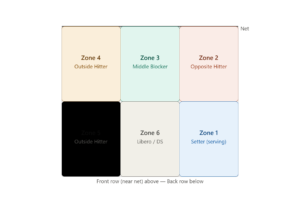
- The court is divided into six numbered zones, numbered 1 through 6
- Zones 2, 3, and 4 are the front row (closest to the net); zones 1, 5, and 6 are the back row
- Every time a team wins back the serve, all six players rotate one position clockwise — the player in zone 1 (right back) moves to zone 6, and so on
- The player who rotates into zone 1 becomes the next server
Why this matters: Because of rotation, every player moves through every zone over the course of a game — even a middle blocker ends up in the back row at some point. Teams manage this using “position switches” right after the serve, where players quickly move to their specialist positions once the ball is in play, while still technically satisfying the rotation order at the moment of serve.
Simple way to remember it: Rotation decides when you serve and where you start each rally — position decides what you do once the ball is live.
How Positions Work Together
Volleyball isn’t about just doing your own job — it’s about connecting with your teammates.
Here’s how it typically flows:
- The libero or DS passes the ball
- The setter runs to set it up
- The outside, opposite, or middle attacks the ball
- Meanwhile, blockers and defenders are adjusting on the other side
Each position relies on the others to do their part, kind of like a puzzle where every piece matters.
Frequently Asked Questions
1. How many positions are there in volleyball?
Answer: There are six main positions in volleyball: outside hitter, opposite hitter, setter, middle blocker, libero, and defensive specialist. Six players from each team are on the court at any given time.
2. What is the easiest volleyball position for beginners?
Answer: Many coaches start beginners as an outside hitter or a defensive specialist, since these positions build core skills — hitting and passing — that transfer to every other position on the court.
3. What’s the difference between a libero and a defensive specialist?
Answer: A libero wears a different jersey, can only play in the back row, and can’t serve, set overhand from the front zone, or attack above the net. A defensive specialist has fewer restrictions and can serve and rotate through more positions.
4. Why do players rotate positions in volleyball?
Answer: Rotation ensures every player takes a turn serving and moves through different zones of the court, keeping the game fair and requiring well-rounded players rather than fixed specialists standing still all match.
5. Which volleyball position is considered the most important?
Answer: The setter is often considered the most important position since they touch the ball on nearly every offensive play and directly control the team’s attacking strategy — though every position plays a role that’s genuinely hard to replace.
Final Thoughts
Understanding the six key volleyball positions—and how rotation ties them together—helps you become a smarter player, coach, or fan. Whether you’re an outside hitter slamming spikes, a setter making split-second choices, or a libero digging impossible balls, every role matters.
The best teams aren’t made of just stars. They’re made of players who know their roles and work together like a machine. So no matter which position you play, own it, learn it, and play it with pride.
Setting up a volleyball court for your school, club, or academy? Gallant Sports designs indoor and outdoor volleyball courts with proper flooring and markings built for serious play — get in touch to plan your setup.
